GÖTTWAIG – WUNDERKAMMER(21) · BAROQUE DIGITAL · ART & SCIENCE · 2026
IMAGO PROXIMA
The world is everything that the next frame is.
GöttwAIg – Wunderkammer(21) is an art & science project exploring the connection between the Baroque – through the cabinet of curiosities of Göttweig Abbey – and digital AI aesthetics. No restoration – an experiment: the fragmentary Göttweig cabinet becomes, through AI, a cabinet of the cabinet; contemporary art as a test lab for translations and AI plausibilities.
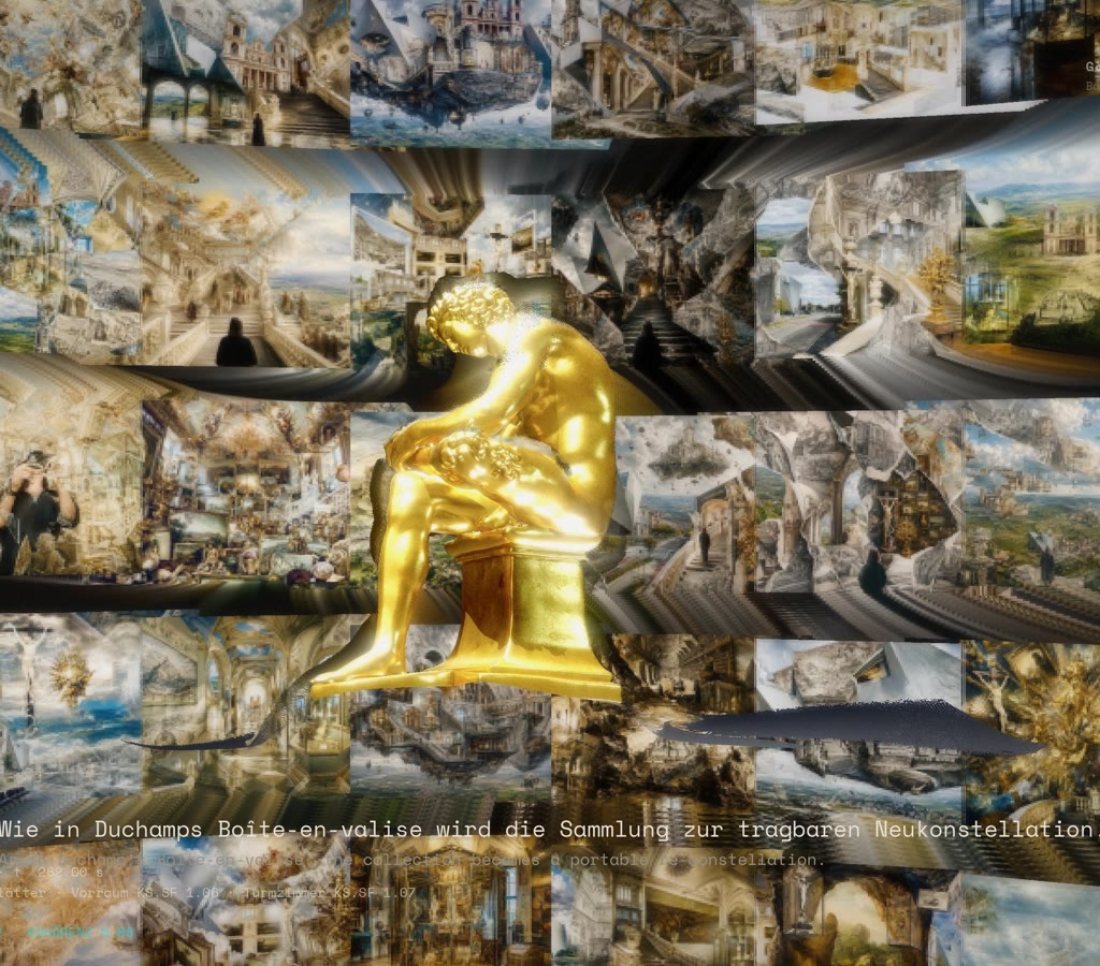
IMAGO PROXIMA – “the next image” – is the new, independent version in the cycle. It reads the cabinet as a world model: like Odyssey’s world models (experience.odyssey.systems), which predict every frame from the previous one and an action, it computes walkable spaces, point clouds, wireframes and new re-collages from 40 AI collages, 26 thorn-puller transformations and 20 GLB models – and lets them arrive in the floor plan of the ante-room and the octagonal tower room of the imperial wing.
“The world is everything that is the case.” – Ludwig Wittgenstein, 1921 · The world model: everything that the next frame is.
IMAGO PROXIMA · long version and trailer
The cabinet as world model
The Göttweig cabinet of art and naturalia, set up under Abbot Gottfried Bessel (1714–1749), survives only in fragments. The great fire of 17 June 1718 opened the collection; what remains is an engraving by Salomon Kleiner (c. 1744), inventories, a boxwood thorn-puller. The project does not fill this gap – it turns it into material.
The next frame. A world model knows no past, only the previous frame and the next action. Odyssey describes its models as causal and autoregressive – a “glitchy dream” that drifts when left alone. IMAGO PROXIMA applies this principle to the Wunderkammer, which was itself a model of the world: microcosm for macrocosm, order out of fragments.
Collages as raw material. The 40 AI collages of EXHIBIT(21) are not played back but processed: a neural network estimates depth from each image; this yields walkable point clouds, wireframe bodies, relief sculptures and strata like the shelves of Kleiner’s engraving. Up to three collages are re-collaged in depth bands into spaces no single image contained.
Drift and evidence. An autoregressive feedback grows every frame out of the previous one; where the camera tears open gaps, the system dreams the missing parts. DRIFT measures how far the world currently deviates from the evidence. Prompts – “open the ceiling”, “17 June 1718”, “show the evidence” – steer the stream.
Boîte-en-valise. As in Duchamp’s Boîte-en-valise, the collection becomes a portable re-constellation – thing and non-thing in one grasp. In chapter IV the 40 sheets fly into a suitcase and then into the floor plan of the exhibition space: ante-room KS.SF 1.06 and the octagonal tower room KS.SF 1.07 in the Museum im Kaisertrakt.
Art, research, innovation. Initiated by Markus Wintersberger (USTP St. Pölten) and Viola Rühse (University for Continuing Education Krems), accompanied by transdisciplinary research and questions of sustainability, with Göttweig Abbey and DruckKunst / Neuhauser Kunstmühle.
Chapters
0 Opening · I MEMORIA · II TRANSLATIO · III HALLUCINATIO · IV BOÎTE · LOCUS · V FUTURUM · End credits
Prompt machine · the next frame
Ante-room and tower room · floor plan
The ante-room is archive, orientation and historical gap; the tower room shows objects, AI, 3D and glass. The window becomes an exhibit – a counter-window towards Krems and the Wachau. No dominant screen.
Collage → space → world model
Monocular depth estimation (MiDaS DPT-Hybrid, Intel ISL) for 72 source images; custom point-splat renderer in Python/NumPy/Numba with z-buffer at 3840 × 2160, depth of field, bloom and an autoregressive frame feedback (zoom, rotation, flow field). Operations: point cloud, wireframe, strata, relief orbit, vortex, explosion, embers, breathing, re-collage of depth bands. Point clouds of the GLB models of the Sketchfab collection drift through the spaces as dream objects.
The floor plan of ante-room and tower room is stored as geometry and drives the film (chapter IV), the GLB scene, the 3D film and the game model. AI collages: co-creation with ChatGPT, 07/2026, based on own photographs, archive material of the Graphic Collection of Göttweig Abbey and project models. Labelled according to AI Art Transparency.
Remix · sonification · space
An independent remix of the project’s compositions from the YouTube playlist GöttwAIg – Wunderkammer(21), granularly stretched and folded into one space, plus a sonification of the score: each world sounds as a chord of its colours (D dorian), transitions as noise arcs, drift as clicks at 25 frames per second, prompts as keystrokes, chapters as bell and sub-bass, and the 40 sheets landing in the floor plan as plucked tones. −16 LUFS.
AI collages EXHIBIT(21) · raw material
Project · sources · partners
- GöttwAIg – Wunderkammer(21) ↗project website
- AR, Mirabilia Machina, collage gallery
- Rühse / Wintersberger, Springer 2026 ↗GöttwAIg: An AI Co-created 21st-Century Reinterpretation of the Cabinet of Curiosities of Göttweig Abbey in Austria
- Odyssey · experience.odyssey.systems ↗world models · Odyssey-3 (8 Oct 2026)
- Sketchfab collection ↗3D / AR artefacts
- USTP research ↗GöttwAIg Wunderkammer(21). Barock digital